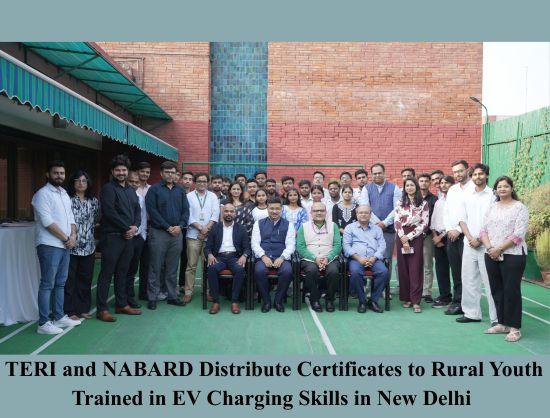
The acceleration of India's electric vehicle (EV) revolution depends not only on manufacturing vehicles and deploying urban fast chargers, but also on creating a robust technical workforce capable of maintaining charging networks across non-metropolitan regions. In a strategic step toward democratizing green technology, The Energy and Resources Institute (TERI) has partnered with the National Bank for Agriculture and Rural Development (NABARD) to deliver specialized EV charging skills training to rural youth.
This initiative bridges a critical gap in the green mobility value chain. While EV adoption rapidly expands across two-wheeler, three-wheeler, and commercial transport segments in semi-urban and rural areas, technical support systems in these regions have traditionally lagged. By equipping young individuals in rural districts with actionable technical knowledge, TERI and NABARD are addressing both rural unemployment and clean transport infrastructure readiness simultaneously.
The Strategic Synergy: TERI and NABARD Collaboration
The collaboration combines the technical, environmental, and research expertise of TERI with the vast rural economic outreach and institutional backbone of NABARD. For decades, TERI has been at the forefront of clean energy research, climate action, and sustainable technology implementation. NABARD, on the other hand, acts as a primary catalyst for rural credit, infrastructure development, and livelihood creation across agrarian ecosystems.
Roles and Core Objectives
- Technical Knowledge Transfer: TERI provides curriculum development, technical modules, and expertise on EV charging protocols, electrical safety, and maintenance.
- Rural Reach and Capital Access: NABARD facilitates grassroots implementation, community mobilization, and alignment with rural enterprise schemes to support trainee placement or entrepreneurship.
- Workforce Decentralization: Shifting technical expertise from centralized urban centers to rural districts ensures immediate, localized technical assistance for electric transport operators.
By blending research-backed educational frameworks with rural financial development strategies, the initiative seeks to establish localized ecosystems capable of sustaining green mobility over the long term.
Why EV Infrastructure Skills Matter for Rural Areas
Much of the public discourse surrounding electric vehicles centers on battery chemistry, range specifications, and high-speed highway chargers. However, the operational reliability of EV networks rests heavily on the presence of skilled technicians who can install, inspect, troubleshoot, and maintain charging points.
In rural and semi-urban geography, electric two-wheelers, e-rickshaws, and small commercial haulers are becoming viable alternatives to fossil-fuel vehicles due to lower running costs. However, rural charging infrastructure faces unique environmental and operational challenges, including grid instability, voltage fluctuations, dust exposure, and localized power distribution constraints. Without trained personnel on the ground to manage hardware upkeep and electrical safety, charger downtime can severely hinder adoption rates.
Integrating EV charging skills training into rural development frameworks directly mitigates range anxiety for rural commuters, agricultural logistics operators, and commercial delivery networks traveling between towns and villages.
Core Technical Competencies Taught in Rural EV Training Programs
Modern electric vehicle charging stations are sophisticated power electronics assemblies that interface directly with power distribution grids, management software, and vehicle onboard computers. A comprehensive training curriculum for rural youth covers several fundamental engineering and operational disciplines.
1. Charger Installation and Hardware Assembly
Trainees are instructed on physical and electrical installation procedures for alternating current (AC) slow/fast chargers and direct current (DC) fast charging equipment. This includes structural mounting, conduit placement, cabling standards, and mechanical protection against environmental hazards.
2. Electrical Safety, Grounding, and Grid Connection
Safety protocols represent a central pillar of the curriculum. Participants learn essential skills such as:
- Proper earthing (grounding) mechanisms to prevent electrical shocks during extreme weather conditions.
- Connecting charging equipment safely to local low-voltage distribution transformers.
- Installing protective circuitry, including residual current devices (RCDs), surge protection units, and circuit breakers.
3. Hardware Diagnostics and Power Electronics Maintenance
EV chargers rely on complex power conversion circuits, microcontrollers, and communication controllers. Training modules cover fault code interpretation, multimeter testing, component replacement, and basic preventive maintenance routine checks.
Understanding power microcontrollers and switching circuits is closely tied to broad advancements in silicon technologies powering modern smart grids. Innovations in power electronics and semiconductor design play a foundational role in enabling efficient energy conversion for EV hardware, a topic highlighted in detailed coverage on advanced semiconductor and micro-processor innovations shaping industrial technology globally.
4. Battery Swapping and Microgrid Integration
In rural markets, battery swapping stations for electric two- and three-wheelers are often more practical than stationary plug-in chargers due to faster turnaround times. Programs cover battery handling, thermal safety, state-of-charge (SoC) management, and integrating chargers with local solar photovoltaic (PV) microgrids to offload stress from main electrical grids.
Real-World Applications and Local Economic Impact
Equipping rural youth with technical skills yields immediate applications across diverse rural economic activities. The impact extends beyond simple employment, fostering local micro-enterprises and strengthening rural transport resilience.
Micro-Entrepreneurship in Charging Hubs
Graduates of the TERI-NABARD program can establish small-scale charging stations or battery swapping kiosks near rural marketplaces, bus stands, and agricultural trade centers (mandis). Supported by NABARD's financial network, local youth can transition from job seekers to clean energy entrepreneurs.
Technical Support for Agricultural Logistics
As electric tractors, cargo three-wheelers, and light commercial vehicles penetrate rural agricultural logistics, localized charging maintenance ensures continuous uptime. Prompt repair services prevent delays in transporting perishable agricultural produce to nearby urban markets.
Solar-Assisted EV Charging Stations
Given the reliance on solar power in remote regions, skilled technicians can manage combined solar-plus-storage charging setups. These hybrid installations utilize rooftop solar panels to charge stationary battery banks during daytime hours, providing clean power for EVs regardless of rural grid load shedding.
Strategic Benefits for the Green Energy Ecosystem
The rollout of targeted rural EV skill development programs provides far-reaching systemic benefits across environmental, economic, and technological metrics.
- Localized Employment Generation: Creates skilled technical jobs directly within rural districts, curbing distress migration to major metropolitan areas.
- Reduced Infrastructure Downtime: Rapid localized repair minimizes charger out-of-service periods, reinforcing user trust in electric mobility.
- Accelerated Last-Mile Decarbonization: Strengthens clean mobility infrastructure across rural delivery channels, small transport fleets, and personal commute routes.
- Optimized Energy Management: Trained technicians ensure that chargers operate safely without causing phase imbalances or severe harmonic distortion on rural power feeders.
Limitations, Operational Risks, and Challenges
While the TERI and NABARD initiative provides a strong framework for rural skill development, several systemic limitations and operational challenges must be acknowledged.
1. Intermittent Rural Grid Infrastructure
In many rural regions, frequent power outages, severe voltage dips, and unannounced load shedding pose operational hurdles for high-speed EV chargers. Even expertly maintained charging hardware cannot function effectively without consistent power supply, requiring additional investments in energy storage systems.
2. Initial Demand vs. Capacity Utilization
In districts where EV adoption is still in its infancy, newly certified technicians may face a temporary shortage of daily servicing work. Until local EV numbers reach critical mass, technical earnings may require supplementation through broader electrical repair services.
3. High Initial Capital Costs for Advanced Hardware
While technical training equips youth with knowledge, setting up commercial-grade DC fast charging stations requires significant upfront capital for transformers, power modules, and safety switchgear. Access to affordable micro-loans remains essential for translation into micro-entrepreneurship.
4. Rapid Technological Evolution
EV charging standards, communication protocols (such as OCPP), and battery management systems undergo frequent software and hardware revisions. Training programs must establish continuous upskilling pathways to prevent technical knowledge from becoming obsolete.
Future Outlook: Scaling Rural EV Skilled Workforce
The strategic drive by TERI and NABARD sets a replicable template for clean energy skill development across emerging economies. As EV adoption grows nationwide, several trends will shape the evolution of rural EV charging skills:
- Standardized Technical Certification: Expansion of standardized certification frameworks recognized nationally by EV manufacturers, charge point operators (CPOs), and government skill councils.
- Integration with Solar Agricultural Schemes: Synergies between EV skill initiatives and agricultural solar pump schemes, creating multi-skilled technicians capable of managing both farm solar setups and EV hardware.
- Digital Diagnostic Tools: Increased reliance on smartphone-based diagnostic software, allowing rural technicians to perform cloud-connected troubleshooting alongside remote engineering support teams.
- Corporate Social Responsibility (CSR) Partnerships: EV OEMs and charging network companies partnering with TERI and NABARD to provide hands-on internship programs and equipment sponsorships.
Conclusion
The collaboration between TERI and NABARD to train rural youth in EV charging skills represents a pragmatic, forward-looking approach to clean energy transition. By decentralizing technical capabilities and placing them directly into the hands of rural communities, the initiative strengthens localized infrastructure while opening clear economic avenues for young technicians. Resolving the dual challenges of rural employment and clean transport accessibility creates a resilient foundation for long-term, sustainable mobility.
Frequently Asked Questions (FAQs)
1. What is the main objective of the TERI and NABARD EV training program?
The primary goal is to train rural youth in technical skills related to installing, operating, maintaining, and troubleshooting EV charging infrastructure. This bridges the technical skill gap in rural areas and promotes green jobs and micro-entrepreneurship.
2. What specific skills do participants learn during the training?
Participants are taught electrical safety practices, AC and DC charger physical installation, grid integration, grounding techniques, power electronics diagnostics, preventive maintenance, and basic operation of battery swapping stations.
3. How does rural EV skill training benefit overall electric vehicle adoption?
By placing trained technicians directly in rural districts, charger downtime is minimized, electrical safety is ensured, and local users gain confidence in switching to electric two-wheelers, three-wheelers, and agricultural transport vehicles.
4. What challenges face EV charging infrastructure in rural areas?
Key challenges include intermittent electrical grid availability, severe voltage fluctuations, high initial costs for setting up fast-charging hardware, and lower initial vehicle density in certain remote districts.
5. Can trained rural youth start their own EV charging businesses?
Yes. With technical expertise provided through TERI's curriculum and potential access to financial schemes facilitated by NABARD or government credit frameworks, certified youth can establish local micro-charging hubs or mobile service units.