 |
| vicor |
As electric vehicle (EV) manufacturers race to deliver faster charging times, extended driving range, and improved vehicle efficiency, the automotive industry is undergoing a fundamental architectural transition. Legacy 400-volt (400V) electrical architectures are rapidly giving way to high-voltage 800-volt (800V) systems. However, stepping up system voltage presents complex engineering hurdles, particularly around power conversion density, thermal efficiency, and packaging constraints inside the battery enclosure.
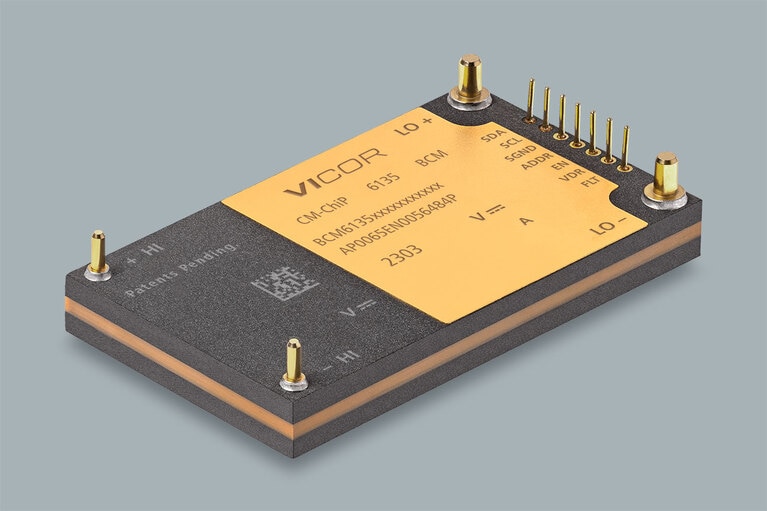
In high-performance automotive power systems, Vicor Corporation has demonstrated how high-density power conversion technology enables innovative 800V battery pack designs. By replacing bulky legacy DC-DC converters with compact, high-density power modules, automotive engineers can optimize space, reduce curb weight, and streamline thermal management. This article explores how advanced power conversion technology is reshaping 800V EV battery design, the engineering advantages it provides, current technical limitations, and the broader outlook for high-voltage power electronics.
The Transition to 800V EV Architectures
For over a decade, mainstream electric vehicles relied on battery packs rated between 300V and 400V. While effective for first-generation EVs, 400V architectures face fundamental physical limitations as consumer demands shift toward ultra-fast charging and higher drivetrain power output.
The Physics of Higher Voltage
Power delivery in an electrical system is governed by the relation Power = Voltage × Current (P = V × I). To increase power output or charging speed in a 400V system, engineers must increase current. Higher current requires thicker, heavier copper wiring and generates internal thermal losses proportional to the square of the current (I²R losses).
By doubling the nominal operating voltage to 800V, the current needed to deliver the same amount of power is cut in half. This current reduction delivers three critical engineering benefits:
- Reduced Resistive Losses: Lower current drastically decreases heat generation across busbars, interconnects, and cabling, improving overall energy efficiency.
- Lighter Wiring Harnesses: Thinner gauge copper cabling can be used throughout the vehicle, yielding measurable weight savings.
- Ultra-Fast Charging Capability: 800V architectures allow vehicles to take full advantage of high-power 350kW+ DC fast chargers, enabling 10-to-80 percent charge times in under 20 minutes.
These gains in efficiency directly complement ongoing efforts in EV battery longevity and next-gen cell technologies, which focus on maximizing operational life and energy retention over extended ownership periods.
The Low-Voltage Conversion Challenge
While an 800V main traction bus offers undeniable benefits for propulsion and fast charging, it introduces significant complexity for the rest of the vehicle's electrical system. Subsystems such as steering actuators, brake-by-wire modules, infotainment, safety systems, and cabin climate controls operate on low voltages—traditionally 12V, but increasingly moving to 48V networks.
The Step-Down Problem
Stepping down power directly from an 800V high-voltage bus to a 12V or 48V auxiliary rail requires an extreme transformation ratio (up to 66:1 for 12V networks). Traditionally, this task fell to a centralized, air- or liquid-cooled DC-DC converter—often housed in a rigid metal enclosure referred to in the industry as a "silver box."
Traditional silver-box converters introduce substantial trade-offs:
- High Mass and Volume: Bulky magnetic components, discrete switching devices, and heavy heat sinks occupy precious chassis space.
- Complex Cable Routing: Routing thick high-voltage cables from the main battery pack to an external converter unit introduces parasitic inductance and potential failure points.
- Thermal Overhead: Centralized conversion creates concentrated hot spots that demand dedicated cooling lines.
Vicor High-Density Modular Power Technology
Vicor's high-density power conversion approach addresses these challenges by substituting bulky discrete converters with miniaturized, high-density power modules. Designed for high power density (measured in kilowatts per liter or grams per watt), these modules enable scalable power architectures that can be integrated directly into or adjacent to the 800V battery enclosure.
High-Frequency Zero-Voltage Switching (ZVS)
A key factor enabling miniaturization in high-density modules is switching frequency. Traditional power converters operate at relatively low frequencies (100 kHz to 300 kHz), which mandates large inductors and capacitors to filter voltage ripple. High-density converters utilize advanced topologies—such as Zero-Voltage Switching (ZVS) and Zero-Current Switching (ZCS)—operating at megahertz frequencies.
Operating at higher frequencies significantly reduces the required physical size of internal passive components like transformers and inductors. This yields power converter modules that are a fraction of the size and weight of traditional units while achieving conversion efficiencies often exceeding 97 percent.
Advanced Packaging and Thermal Integration
High power density creates concentrated heat that must be dissipated effectively. Modern high-density modules employ planar magnetic structures and advanced surface-mount packaging (such as Vicor’s Converter housed in Package / ChiP technology). These packages feature low thermal resistance, allowing heat to be transferred out through top and bottom surfaces directly into the vehicle's cooling plates or battery cold plates.
Key Architectural Benefits for 800V Battery Packs
Integrating high-density power conversion directly into 800V battery pack designs unlocks structural and operational benefits for automotive OEMs.
1. Elimination of the Traditional 12V Lead-Acid Battery
By leveraging high-density converter modules with fast transient response rates, automotive engineers can establish a "virtual" low-voltage battery. The high-density module steps down 800V power to 12V or 48V instantaneously, supplying low-voltage rails directly from the traction pack. This enables manufacturers to eliminate heavy 12V lead-acid or auxiliary lithium-ion batteries entirely, saving up to 15 kg of vehicle weight.
2. Package Optimization and Battery Volumetric Density
Because high-density conversion modules are low-profile and compact, they can be mounted inside the battery tray, placed on busbars, or integrated directly into the Battery Management System (BMS) PCB. Eliminating external DC-DC converter enclosures frees up space that can be reallocated to active battery chemistry, directly increasing total pack capacity and driving range.
3. Modular and Scalable Power Systems
Modular power conversion allows engineers to scale power capability in parallel. Rather than redesigning a completely custom DC-DC converter for every new car trim or battery size, engineers can add or remove standard high-density conversion modules to match specific power demands across an entire platform portfolio.
Real-World Applications and Regional Market Dynamics
High-density 800V power conversion is playing a pivotal role across several sectors of modern transportation and power electronics.
Passenger Electric Vehicles and Performance Cars
High-performance luxury EVs and modern mass-market platforms are the primary early adopters of 800V architectures. Vehicle manufacturers utilizing high-density power conversion benefit from reduced drag and mass, translating into improved efficiency per kilowatt-hour. Regional vehicle rollouts, including commercial expansions such as the MG Hector Tomahawk and expanding regional EV offerings, highlight the growing consumer demand for advanced drivetrain tech and faster charging solutions.
Heavy-Duty and Commercial Transport
Commercial trucks, transit buses, and off-highway machinery require continuous high-power delivery. In these applications, power conversion weight and volume directly impact payload capacity. High-density 800V step-down architectures enable heavy-duty platforms to power high-draw auxiliary loads—such as hydraulic pumps, air compressors, and refrigeration units—without needing bulky secondary power units.
Global Supply Chains and Semiconductor Ecosystems
The manufacturing and deployment of advanced power conversion technologies are deeply tied to global semiconductor manufacturing and regional hardware integration. As highlighted in discussions surrounding semiconductor trade dynamics and wide-bandgap chip supply, secure access to Silicon Carbide (SiC) and Gallium Nitride (GaN) devices is crucial for power module production. Furthermore, expanding supply chains across emerging electronics manufacturing hubs, such as India's electronics supply chain integration, underscores the global nature of modern EV power hardware production.
Engineering Limitations, Risks, and Challenges
Despite its advantages, implementing high-density power conversion within 800V battery systems presents distinct technical and financial challenges that engineers must navigate.
1. Electromagnetic Interference (EMI) and Noise Management
Operating power devices at megahertz frequencies and high switching speeds (high dV/dt and dI/dt) generates substantial high-frequency electromagnetic noise. Without careful PCB layout, shielding, and differential filtering, EMI can disrupt sensitive low-voltage signals in the vehicle's controller area network (CAN) or Ethernet buses.
2. High-Voltage Insulation and Safety Standards
800V designs require strict adherence to creepage and clearance distances to prevent arc-over, electrical breakdown, and short circuits. Integrating high-voltage conversion hardware inside tight battery pack cavities demands specialized potting materials, high-dielectric isolation barriers, and stringent compliance with functional safety standards like ISO 26262 (ASIL-D).
3. Thermal Concentration and Hot-Spot Dissipation
While high-density modules achieve exceptional power conversion efficiency, the tiny surface area over which power loss occurs creates intense localized heat flux. Passive heat sinks are insufficient; systems must be carefully engineered to couple module thermal pads directly to liquid cooling cold plates or battery pack cooling circuits.
4. Cost Considerations
Advanced planar magnetics, specialized packaging, and high-frequency wide-bandgap semiconductors carry higher upfront bill-of-materials (BOM) costs compared to legacy discrete power designs. Vehicle manufacturers must weigh the higher component cost against systemic savings achieved through reduced cabling mass, eliminated secondary batteries, and simplified assembly.
Future Outlook: The Evolution of High-Voltage Power Systems
The continuous push toward lighter, faster-charging electric vehicles guarantees that high-density power conversion will remain a focal point of automotive engineering innovation.
Integration with Wide-Bandgap Semiconductors
Future iterations of high-density conversion modules will rely heavily on Gallium Nitride (GaN) and advanced Silicon Carbide (SiC) power switches. These materials feature higher breakdown voltages, faster switching kinetics, and lower on-resistance than traditional silicon, paving the way for even smaller power modules with efficiency figures approaching 99 percent.
800V-to-1000V+ Industrial Architectures
As fast-charging standards evolve toward 450kW and beyond, extreme high-voltage architectures operating near or above 1000V are being evaluated for long-haul trucking and aerospace applications. High-density modular power architectures are uniquely positioned to address these extreme voltages because modules can be connected in series or stacked to manage higher voltage drops safely.
Bidirectional Power Flow and Smart Grid Integration
Next-generation battery packs are increasingly designed for Vehicle-to-Grid (V2G) and Vehicle-to-Load (V2L) operation. Future high-density power conversion units will likely incorporate fully bidirectional power transfer natively, enabling 800V traction batteries to seamlessly feed AC power back to home energy management systems or emergency equipment without requiring external inverters.
Conclusion
Vicor's high-density power conversion technology illustrates how innovative hardware design can overcome the physical space and thermal constraints of modern 800V EV battery architecture. By transitioning from bulky legacy DC-DC converters to miniaturized, highly efficient power modules, automotive engineers can eliminate unnecessary vehicle weight, simplify low-voltage power distribution, and optimize available battery volume.
Although challenges around thermal dissipation, high-frequency EMI, and initial implementation costs remain, the architectural advantages of high-density conversion align directly with the EV industry's goals of faster charging, higher efficiency, and extended driving range. As high-voltage architectures become the benchmark across global electric transport, high-density power conversion will serve as a key technological cornerstone driving modern automotive engineering forward.
Frequently Asked Questions (FAQ)
1. What is high-density power conversion in an 800V battery pack?
High-density power conversion refers to the use of highly integrated, compact power modules that convert high-voltage electricity (such as 800V from a traction battery) down to lower operational voltages (like 12V or 48V) using high-frequency switching and advanced packaging. This minimizes the physical size and weight of the power conversion equipment.
2. Why are EV manufacturers moving from 400V to 800V architectures?
Switching to 800V allows electric vehicles to deliver higher power while cutting electrical current in half. Lower current reduces resistive heating losses and enables thinner wiring harnesses, resulting in reduced weight, higher overall drive efficiency, and significantly faster DC fast-charging speeds.
3. How does Vicor's technology help reduce vehicle weight?
By using miniaturized high-density modules with extremely fast transient response times, engineers can draw 12V or 48V power directly from the main 800V traction pack as needed. This enables OEMs to eliminate heavy legacy DC-DC converter boxes as well as traditional 12V lead-acid auxiliary batteries.
4. What are the main challenges of high-density power conversion?
Key engineering challenges include managing high localized thermal flux (heat dissipation in a tiny area), controlling electromagnetic interference (EMI) caused by high switching frequencies, ensuring high-voltage isolation compliance, and balancing higher component costs against system-level weight and space savings.
5. Can modular power conversion be used with both 12V and 48V vehicle systems?
Yes. Modular power designs allow engineers to configure step-down conversion for standard 12V networks, 48V mild-hybrid/auxiliary networks, or dual 12V/48V systems by selecting or combining standard high-density modules without requiring a complete redesign of the vehicle's electrical architecture.
