 |
| Cybersecurity |
In contemporary industrial operations, the line separating physical safety from digital security has permanently dissolved. As operational technology (OT) and Industrial Control Systems (ICS) undergo rapid digital transformation, industrial organizations face unprecedented risks that span both the digital and physical domains. According to recent expert analysis by Barreto Jijón from OT-Knight, modern compliance with international ISA/IEC standards explicitly requires an integrated safety and cybersecurity approach across industrial control environments.
Historically, plant engineers treated functional safety—designed to protect human life, machinery, and the environment from equipment failures—as an entirely separate discipline from cybersecurity. However, interconnected networks, remote telemetry, and smart sensors mean a cyber compromise can directly override or disable critical Safety Instrumented Systems (SIS). Adopting a unified risk management framework based on ISA/IEC standards is no longer merely an enterprise recommendation; it is an operational prerequisite for resilience.
Understanding the Convergence of Safety and Cybersecurity in OT
The operational technology ecosystem relies heavily on automated feedback loops where sensors, logic solvers, and final control elements work together to control industrial processes. To grasp why integrated safety and cybersecurity is mandatory, it is essential to examine how these two domains have evolved from isolated operational groups into unified engineering frameworks.
The Historical Separation of Functional Safety and OT Security
For decades, safety instrumented systems relied on physical isolation, proprietary fieldbus protocols, and dedicated wiring. Safety engineers designed these systems assuming that failures resulted exclusively from random hardware degradation, software bugs, or human operator error. Operational technology was assumed to be immune to cyber threats because plants operated behind isolated, air-gapped perimeters.
Consequently, safety engineers concentrated on calculating Safety Integrity Levels (SIL) under standards like IEC 61508 and IEC 61511. Meanwhile, IT security departments focused on firewalls, user authentication, and data confidentiality across corporate networks. This division created severe blind spots, as safety systems were rarely audited for digital vulnerability or unauthorized firmware modifications.
The Mandate of Modern ISA/IEC Frameworks
Today, the air gap is widely recognized as a legacy concept. Modern industrial facilities connect plant floors directly to enterprise resource planning systems, cloud analytics platforms, and vendor remote monitoring interfaces. Recognizing this reality, standards organizations updated their frameworks to mandate integrated safety and cybersecurity.
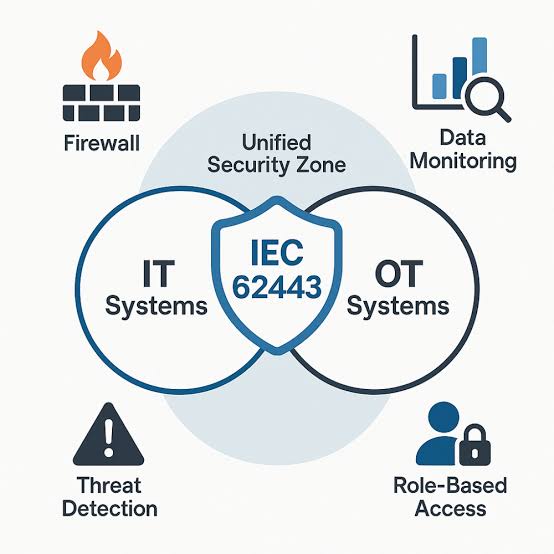
The ISA/IEC 62443 standard series explicitly addresses the cybersecurity lifecycle for Industrial Automation and Control Systems (IACS). When paired with functional safety standards like IEC 61508 (for equipment manufacturers) and IEC 61511 (for the process industry sector), the mandate becomes clear: safety cannot exist without security. If an attacker can alter controller logic, spoof sensor readings, or tamper with valve limits, the functional safety mechanisms of the facility are rendered ineffective.
This holistic convergence is taking center stage across global industry forums. For example, international discussions highlighting the evolution of industrial defense strategies, such as those showcased at GISEC Global 2026, emphasize that safeguarding infrastructure requires bridging technological and organizational boundaries.
Why Integrated Risk Assessment Is Essential for Industrial Control Systems
Traditional safety risk assessments, such as Hazard and Operability Studies (HAZOP) or Process Hazard Analysis (PHA), evaluate mechanical, chemical, and electrical failure modes. However, standard PHAs typically assume that safety devices perform as designed when triggered. A cyber attack fundamentally violates this assumption by intentionally manipulating or blinding safety logic.
Aligning Safety Integrity Levels (SIL) with Security Assurance Levels (SL)
To resolve this gap, integrated risk assessments establish a direct mapping between Safety Integrity Levels (SIL) and Security Levels (SL) defined in ISA/IEC 62443. This alignment allows safety and security teams to evaluate threats through a common lens:
- Safety Integrity Level (SIL): Quantifies the target level of risk reduction provided by a safety instrumented function based on the probability of failure on demand.
- Security Level (SL): Defines the capability of a system to resist intentional malicious attacks based on threat actor capability, vectors, and attack objectives.
If a safety loop relies on a programmable logic controller (PLC) rated at SIL 3, but the network connection to that PLC lacks encryption, access control, or monitoring (operating at SL 1), the overall safety assurance of that loop drops significantly. Modern compliance guidelines require that the digital infrastructure supporting a safety function meets a Security Level compatible with the safety function's SIL rating.
Evaluating Cyber-Induced Physical Hazards (Cyber PHA)
To satisfy ISA/IEC standards, organizations are adopting specialized methodologies like Cyber Process Hazard Analysis (Cyber PHA) or Security-HAZOP (SecHAZOP). These exercises systematically evaluate how a cyber incident could trigger physical hazards:
- Can an unauthorized write command manipulate a pressure relief valve setting?
- Could spoofed temperature telemetry trick a logic solver into suppressing an alarm?
- What happens if a denial-of-service attack overwhelms the fieldbus network during an overpressure event?
By evaluating these scenarios, engineering teams ensure that cyber-attack vectors are factored directly into safety system design and emergency response plans. Bridging these operational gaps often requires specialized advisory and technical consultation, similar to how broad enterprise security architectures are evaluated by managed service specialists such as AdRem Systems Corporation when aligning technical operations with enterprise compliance.
Real-World Engineering Use Cases and Practical Implementations
Integrating safety and cybersecurity requires concrete technical architectures rather than abstract concepts. Below are key practical scenarios illustrating how integrated protection functions across critical sectors.
1. Process Industry: Safeguarding Emergency Shutdown Systems (ESD)
In oil refineries, petrochemical plants, and chemical manufacturing facilities, Emergency Shutdown (ESD) valves serve as the final barrier against pressure explosions or hazardous leaks. Under an integrated framework based on ISA/IEC 62443-3-3 and IEC 61511:
- Network Segmentation: ESD controllers are isolated in dedicated Safety Zones with strict conduit controls restricting inbound traffic.
- Cryptographic Verification: Fieldbus communication between safety sensors and logic solvers utilizes signed, encrypted protocols to prevent man-in-the-middle attacks.
- Read-Only Interlocks: Hardware key-switches physically block remote configuration changes during normal operations, ensuring that network compromise cannot rewrite safety thresholds.
2. Power Generation and Utilities: Protecting Water Dosing and Grid Interlocks
Municipal water treatment plants and electrical power generation facilities rely on distributed control systems (DCS) to govern chemical chemical addition and power distribution. In these environments, applying integrated controls prevents catastrophic misconfiguration:
- Out-of-Band Physical Overrides: Mechanical or non-programmable hardwired trip circuits are retained parallel to digital controllers to ensure safe shutdown even if the DCS network is compromised.
- Continuous Passive Monitoring: Deep Packet Inspection (DPI) tools analyze OT network traffic in real time to flag unauthorized command parameters before they reach execution switches.
Benefits of Merging Safety and Cybersecurity Operations
Consolidating functional safety and cybersecurity workflows delivers substantial technical and organizational advantages to industrial operators:
- Comprehensive Threat Visibility: Unifying safety event logs with cybersecurity intrusion detection system (IDS) telemetry provides a complete picture of plant health, preventing physical malfunctions from being misdiagnosed as pure hardware failures.
- Regulatory and Audit Readiness: Compliance with ISA/IEC 62443 and national critical infrastructure regulations becomes significantly simpler when safety and security documentation share common risk assessment metrics.
- Reduced Unplanned Downtime: Proactive identification of cyber vulnerabilities within safety instrumented systems reduces the risk of accidental plant trips or malicious operational shutdowns.
- Optimized Capital Expenditure: Shared engineering assessments eliminate redundant hardware purchases, streamlined cabling, and duplicated security audits.
As corporate demand for specialized OT security tools accelerates, enterprise security vendors have expanded their capabilities to protect industrial environments. This growth reflects broader market trends where leading enterprise security firms—such as those analyzed in comprehensive market evaluations like Check Point Software's strategic analysis—continue to build out dedicated OT threat intelligence and network protection solutions.
Implementation Challenges, Limitations, and Technical Risks
Despite the undeniable advantages, implementing an integrated safety and cybersecurity strategy carries technical and operational challenges that engineering leadership must navigate carefully.
Cultural and Organizational Silos
Historically, safety engineers and cybersecurity specialists belong to separate corporate organizations with contrasting goals. Safety engineers prioritize system availability, process uptime, and proven operational stability above all else. Cybersecurity teams prioritize confidentiality, active vulnerability patching, and rapid access control changes. Overcoming this cultural divide requires cross-training safety personnel on OT threat vectors and educating cybersecurity teams on functional safety principles.
Legacy Hardware Constraints
Many active industrial control systems were manufactured decades ago when controllers had modest processing power and minimal memory. Legacy PLCs and RTUs often cannot process cryptographic certificates, host endpoint detection software, or handle complex encryption overhead without introducing unacceptable signal latency. Replacing certified, operational safety equipment purely to add network encryption requires significant capital outlay.
The Patching Dilemma in Certified Systems
In standard IT environments, security patching occurs on a frequent, automated cadence. In contrast, applying a software patch to a certified Safety Instrumented System requires extensive re-validation, functional testing, and potential plant shutdown. If a safety patch alters underlying control timing, it risks invalidating the device's SIL certification. Consequently, OT teams must balance patch management against potential operational disruption.
This operational friction highlights why demand for specialized technology integrators and regional cybersecurity services continues to grow globally, as highlighted in market assessments like those for Excite Technology Services during phases of rising service complexity.
Future Outlook: AI, Evolving Standards, and Modern Defense-in-Depth
Looking ahead, the convergence of safety and cybersecurity in OT environments will deepen as technologies evolve and standards committees update their frameworks.
Machine Learning and Anomaly Detection in Safety Loops
Future industrial control architectures will increasingly incorporate artificial intelligence at the edge to perform continuous safety-security validation. By analyzing millions of physical process data points alongside network packet metadata, AI models can detect subtle operational deviations—such as minor pressure anomalies paired with unusual network read commands—far faster than human operators or traditional rules engines.
Formalized Joint Certification Standards
Standards bodies such as the International Electrotechnical Commission (IEC) and the International Society of Automation (ISA) are actively working to further harmonize ISA/IEC 62443 and IEC 61511. Future revisions will likely include explicit compliance checklists for joint Safety-Security hazard assessments, making cyber-safety verification mandatory for obtaining facility operating permits.
Zero Trust Adapted for Operational Technology
The adoption of Zero Trust Architecture (ZTA) principles within OT networks will expand. By enforcing micro-segmentation, continuous identity verification, and strict protocol filtering down to individual field devices, organizations can isolate safety loops from broader enterprise network compromises entirely.
Frequently Asked Questions
What is the core takeaway of Barreto Jijón's analysis regarding ISA/IEC standards?
Barreto Jijón emphasizes that ISA/IEC standards mandate treating functional safety and cybersecurity as a single, unified domain. Because cyber attacks can directly override physical control parameters, safety instrumented systems cannot guarantee human and environmental protection unless the underlying OT cybersecurity posture is equally rigorous.
How do ISA/IEC 62443 and IEC 61511 work together?
IEC 61511 defines the functional safety requirements for designing, operating, and maintaining safety instrumented systems in the process industry. ISA/IEC 62443 provides the cybersecurity framework for protecting those same industrial automation systems. Together, they ensure that safety functions remain resilient against both physical equipment failures and malicious cyber threats.
Why can't traditional IT security tools protect industrial safety systems?
Traditional IT security tools are designed for high-bandwidth networks and prioritize data confidentiality. Standard IT scanning tools can inadvertently overload resource-constrained PLCs, causing control logic locks or unexpected plant shutdowns. OT systems require low-latency, deterministic protocol inspection and passive monitoring tools designed specifically for industrial environments.
What is a Cyber Process Hazard Analysis (Cyber PHA)?
A Cyber PHA is an integrated risk assessment methodology that combines traditional process hazard analysis with cybersecurity threat modeling. It evaluates how specific cyber vulnerabilities, unauthorized access vectors, or network exploits could directly cause physical hazards, such as overpressure, chemical releases, or equipment destruction.
How should plant operators manage security patches on certified safety controllers?
Plant operators should implement a risk-based patching strategy using compensatory controls. When immediate patching would disrupt certified safety functions, operators rely on network micro-segmentation, physical lockouts, passive network monitoring, and strict access controls to mitigate threats until planned maintenance outages allow for certified firmware updates.
Conclusion
The insights highlighted by Barreto Jijón reinforce an essential truth for modern industrial management: functional safety and cybersecurity are two sides of the same coin. In an era where physical industrial infrastructure is deeply interconnected with digital networks, relying on isolated security models creates severe operational risk.
By fully aligning operations with integrated ISA/IEC standards, conducting Cyber Process Hazard Analyses, and unifying safety and security teams, organizations can safeguard their workforce, protect physical assets, and maintain resilient operations against an evolving global threat landscape.